

Apex, N.C., August 6, 2026— LiveSwitch, the world-leading communications platform for small businesses and entrepreneurs, today released findings from its second-quarter Lunchbox Survey, a pulse check on service business owners and operators.
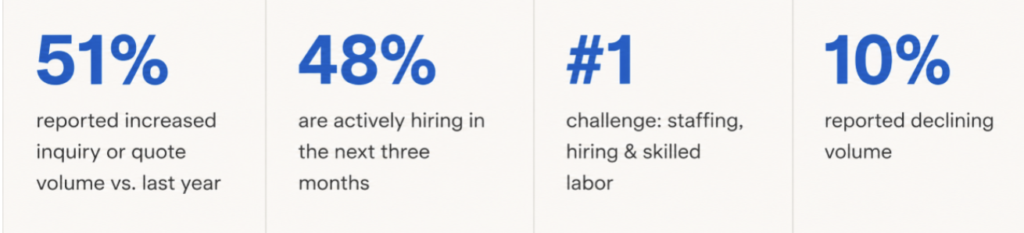
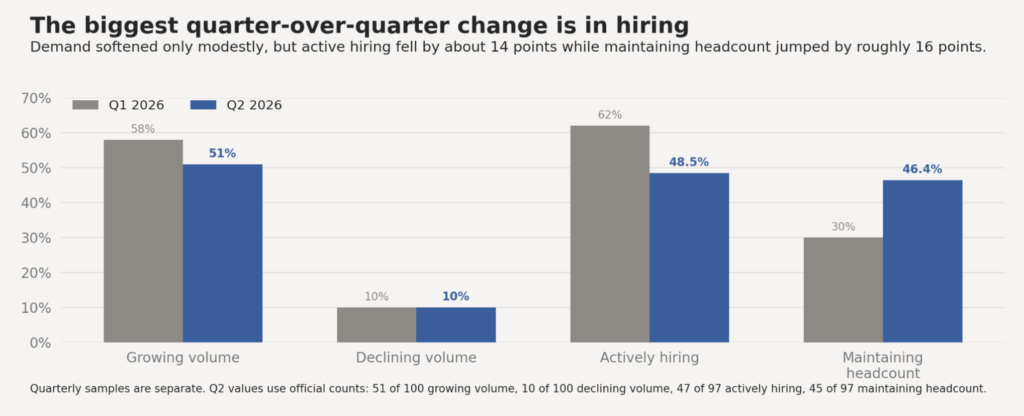
The defining story of the second quarter is that business volume remains strong, but hiring has slowed down. Fifty-one percent of respondents report that their volume of new inquiries or quotes increased compared with this time last year. Another 39% report stable lead volume, while just 10% report any decline.
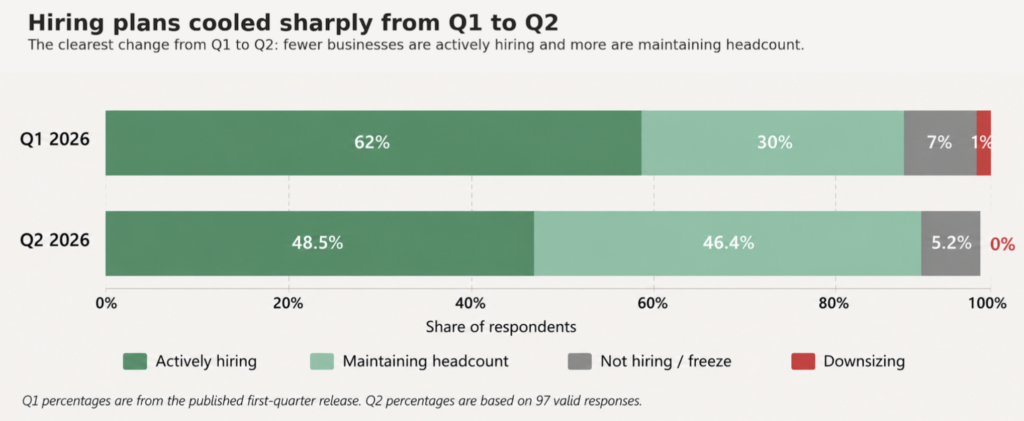
The more significant change from Q1 is in hiring. Forty-eight percent of respondents say they are actively hiring in the next three months, down from 62% in the first-quarter release. Meanwhile, 46% say they are maintaining headcount, up from 30% in Q1. The shift suggests that small businesses still see growing demand, but economic pressures are bringing caution.
Open-ended responses to the question asking the biggest challenge facing their business help explain that caution. Owners repeatedly pointed to rising costs and inflation, difficulty staffing and finding skilled talent, and the need to protect efficiency while managing demand.
Demand Remains Resilient from Q1 to Q2
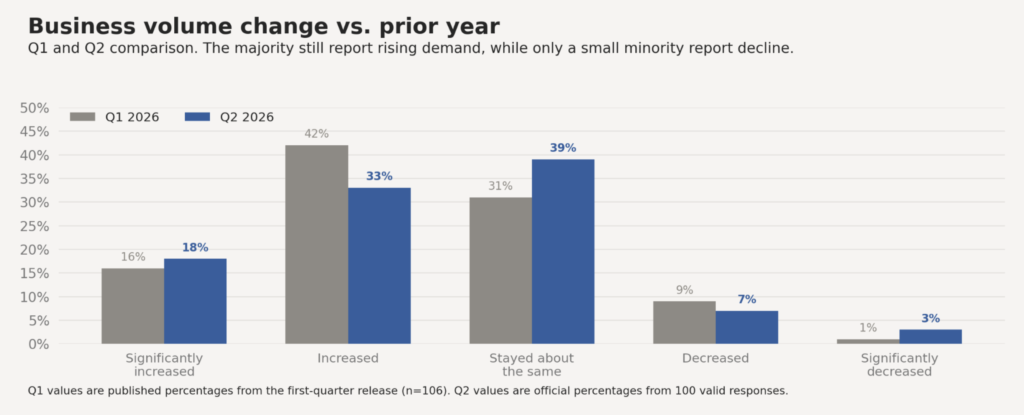
When asked how their volume of new inquiries or quotes has changed compared with the same period a year ago, 33% of respondents reported that volume increased and another 18% reported that it significantly increased. Thirty-nine percent reported that volume stayed the same, while only 7% reported a decrease and 3% reported a significant decrease. In all, 51% of respondents saw more leads this year compared to last year, and only 10% experienced declining inquiries.
In total, nine in ten respondents reported that demand was either stable or growing. Compared with the Q1 results, the percentage of respondents reporting growth in new business slipped by seven percentage points, from 58% to 51%, but the overall message is consistent: most small businesses are still seeing healthy demand and relatively few are reporting outright decline.
Hiring Slows Sharply Compared With Q1
Hiring intent softened much more sharply than demand. Of the businesses that reported their hiring intent in the most recent quarter, 48.5% say they are actively hiring during the next three months and 46.4% plan to maintain their existing headcount. An additional 5.2% say they would not hire even if someone leaves, and none reported plans to downsize.
Compared with the Q1 results, hiring intent fell by roughly 14 percentage points, while those maintaining headcount rose by roughly 16 points. The second-quarter survey results indicate that businesses did not suddenly lose demand, rather more of them moved from a strategy focused on expansion into a more cautious hold-steady position.
Growing Businesses Still Drive Most Hiring
The relationship between business volume and hiring remains strong. Among the respondents who reported growing inquiry volume and answered the hiring question, 65% are actively hiring. In contrast, 37% of businesses reporting stable demand, and 10% of businesses reporting declining demand responded that they are actively hiring.
Growing businesses account for 67% of the active-hiring responses. Stable businesses are more evenly split between hiring and maintaining headcount, while businesses experiencing declining demand overwhelmingly plan to hold their current teams rather than add workers.
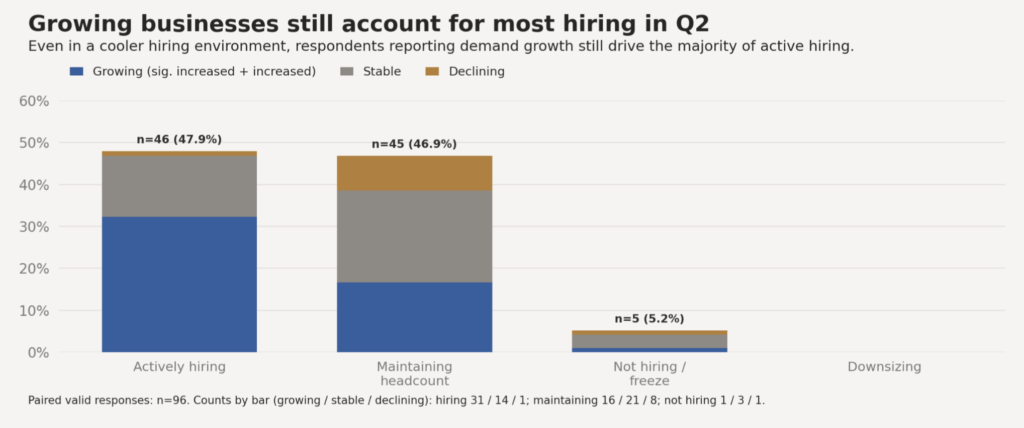
These results show that hiring has not disconnected from demand. Businesses that are growing are still the most likely to add people. The change is that fewer owners are choosing to expand aggressively, and more are trying to meet demand with the teams they already have.
Staffing Pressure and Rising Costs Define the Q2 Picture
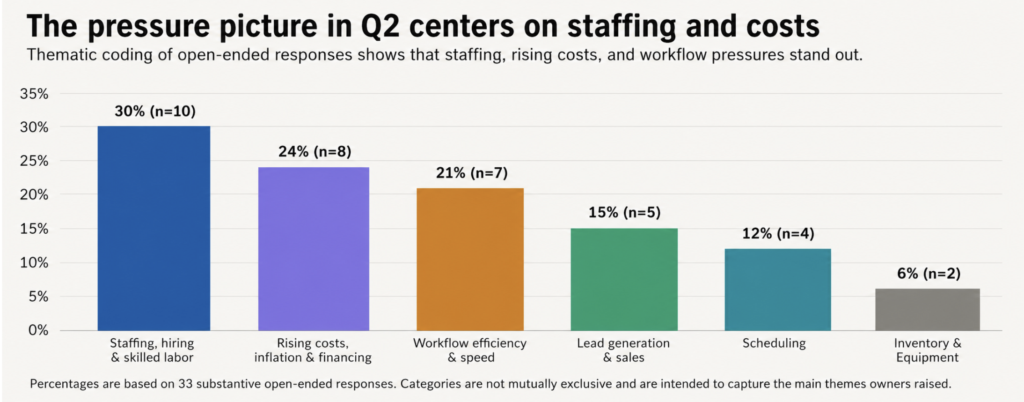
Responses to the survey’s open-ended question—”What is the biggest challenge facing your business?”— point to a small-business environment shaped by staffing constraints, rising costs and the pressure to operate more efficiently. Because many responses touched on more than one issue, the categories are not mutually exclusive.
Staffing, Hiring and Skilled Labor
Staffing was the most frequently cited challenge, appearing in 30% of responses. Owners mentioned difficulty recruiting dependable employees and training new hires. Respondents specified difficulty finding “quality workers” and “good help.”
The responses suggest that the issue is not simply whether businesses want to hire. Many are struggling to find workers with the skills, experience and reliability they need. That labor constraint may be one factor behind the sharp decline in active hiring from Q1 to Q2, even as demand remains relatively resilient.
Rising Costs, Inflation and Financing
Rising costs, inflation and financing pressures appeared in 24% of responses. Owners cited fuel, insurance, marketing, energy prices, interest rates and broader inflationary increases. A1A Moving & Relocation Services described a “slow market, high cost of operation, especially insurance, fuel and marketing.”
Those pressures are likely a factor in owners’ more cautious decisions about growth. Even when demand is present, higher costs can make businesses less willing to add payroll or invest ahead of future work.
Workflow Efficiency and Speed
Twenty-one percent of respondents identified workflow efficiency and speed as a challenge. Several businesses focused on producing estimates faster, reducing paperwork and removing internal bottlenecks.
Voity Electrical described the tradeoff directly: the company needs to get estimates out without pulling its master electrician away from fieldwork. Other respondents mentioned streamlining estimating, responding to customers faster and maintaining focus on the activities most likely to drive growth.
Conclusions
The Q2 LiveSwitch Lunchbox Survey points to a small-business economy that still has demand, but is under economic pressure to become more selective about expansion.
The likely explanation is a combination of cost pressure and labor friction. Small businesses are seeing work come in, but many are also managing inflation, higher operating costs and persistent difficulty finding skilled talent. These challenges are pushing more owners to maintain their current headcount, protect margins and focus on getting more from the teams they already have.
“Our survey shows that inflation doesn’t stop the air conditioner from breaking, so the phones are still ringing for the small businesses that built America. At the same time, higher costs are forcing them to do more with less,” said Brian Hamilton, co-founder of LiveSwitch.
LiveSwitch Lunchbox Methodology
The LiveSwitch Lunchbox Survey is a quarterly pulse check of the small businesses LiveSwitch serves. The second-quarter survey ran from June 26 through July 14th, 2026, and received 101 responses from owners and operators across moving and storage, electrical services, construction, home services, landscaping, restoration and other service industries.
Quarter-over-quarter comparisons use the published percentages from the first-quarter Lunchbox survey. The comparisons are intended to identify directional changes rather than track the same businesses over time.
About LiveSwitch:
LiveSwitch is eliminating the technology gap for small businesses with a cutting-edge AI and communication platform that delivers enormous productivity gains. Leading with agentic AI, we are transforming the way trades do business. Our aim is to increase the 10-year survival rate of U.S. small businesses by 25% over the next five years. When businesses use our platform, they have a better chance to succeed, with customers reporting an average rate of return of 214%.